Showing posts with label quotes and illustrations. Show all posts

Saturday, 28 December 2013

Alex James on Celebrity


Christmas is a great time to sit and read and let the world go by a bit.  We had a great Christmas, services were well attended and (I'm told) well received as well.   Now a bit of time to eat, drink, sleep, and read.  

Interesting read, "Bit of a Blur", the Alex James autobiography. (He was the bass player in Blur) He estimates that he spent a million pounds on champagne and cocaine, slept with dozens of fans and models, and stayed in decadent luxury around the world. Yet, at the 'height' of it all, he says, 

"This was the top of the hill. What else could life hold? It's funny, but when I look back I think that period of my life was the bottom of a pit, rather than Mount Fantasticus. I was a morally bankrupt, drunk fatso with a stupid grin and a girlfriend with a murdered heart." (Quote sanitized a bit).    

It's on page 225, if you want to verify it.  

Tuesday, 5 November 2013

What it's all about


Sunday was the best - a baptism service for two people in the congregation.  We had a packed church and a great service.  Quite apart from the boost that baptism gives to the people going under the water, the church gets a lift from it.  Because this is what it's all about for Christians (Baptists in particular?).  Seeing grown ups deciding that they want to take the plunge - as it were.  


You see, we don't christen or baptise babies or children, though we are happy to give thanks for them and pray for them.  We figure that it's something that kids need to make their own minds up about, and in due course, when they are old enough, we baptise them.  We use a lot of water too.  Maybe it says something of the extravagance of  grace.  

Came across a great passage from a children's book just last week about baptism and how wrong people can get it.  This is from the point of view of a child:


"I'd heard about Baptists from Jacob Henry's mother.  According to her, Baptists were a strange lot.  they put you in water to see how holy you were.  Then they ducked you under the water three times.  Didn't matter a whit you could swim or no.  If you didn't come up, you got dead and your mortal soul went to Hell.  But if you did come up, it was even worse.  You had to be a Baptist."  
Robert Newton Peck, "A Day No Pigs Would Die"

It's true we're a strange lot.  But surviving baptism doesn't make you a Baptist.  It's a public declaration that you have become a follower of Jesus - other denominations are available. Though, obviously, they aren't so good...  

A great day.  For all the things that we are involved in as a church - this is what it's all about.


Tuesday, 25 June 2013

The Joy (and Pain) of Christian Community


Been enjoying the excellent 'A Meal With Jesus' by Tim Chester and could identify with this quote, as I am sure could anyone pursuing Christian community... 

"This is my experience:  the Christian community often wears me out, winds me up and drives me crazy.  But I also have moments when I look at my brothers and sisters and know the presence of the risen Christ.  It’s not that my community is anything special.  Yet there are moments when I see Christ incognito among the ragtag people sitting in my front room - and then it seems he’s gone again.  You see it in our diversity - a diversity that has no explanation except the work of God.  You see it when people’s hearts burn as God’s Word is interpreted.  You see it in the love people show to one another."


Tim Chester, p.147, A Meal With Jesus

Wednesday, 12 June 2013

Myers-Briggs Personality Types in the Bible

A friend shared this on his Facebook page and I am reposting it here for fun and so that I can find it if ever I want it.  Thanks to Tony Watkins for reposting it.  Clever. 

Saturday, 23 February 2013

Thank God For Parking Tickets


Just finished John Lanchester's book, a very readable and intelligent book - to my mind.  I liked this passage seen from the viewpoint of a woman who is working as a traffic warden:

"When you gave people a ticket they were angry, always and inevitably.  And the anger could spread, and become catching, as it had with this plainly mad woman, crazed with resentments.  There were times when she wanted to say: Get down on your knees! Be grateful! A billion people living on a dollar a day, as many who can't find clean drinking water, you live in a country where there is a promise to feed, clothe, shelter and doctor you, from the moment of your birth to the moment of your death, for free, where the state won't come  and beat or imprison you or conscript you, where the life expectancy is one of the longest in the world, where the government does not lie to you about Aids, where the music is not bad, and the only bad thing is the climate, and you find it in yourself to complain about parking?  Woe, woe!  Down on your knees in gratitude that  you can even notice this minor irritation!  Praise God for the fact that you resent getting this ticket, instead of rending your clothes with grief because you lost another child to dysentery or malaria!  Sing hosannas when you fill out the little green form in the envelope stuck to your windshield! For you, you of the deservedly punished five-minute overstay, you of the misinterpreted residents' bay area, you of the ignored Loading Only sign, are of all people who have lived the most fortunate!"  
                                                                                                                                                (p.212-3)

A great reminder about perspective and being grateful for all the things we rarely think about.

Friday, 22 February 2013

A walk in the woods


A grand day out yesterday.  Very cold up on Exmoor but bright enough to tempt me down with camera in hand to visit Snowdrop Valley near Wheddon Cross.  By the time I'd traveled down the sun had pretty much disappeared but it was still worth it.  I enjoyed the rare delight of playing my choice of music loud (Scritti Politti's Anomie and Bonhomie, completests) without disparaging comment from family members on the way down and the two or three mile walk was good for me.


Topped off with a great curry, a dreadful film (Knowing) and a couple of glasses of red wine, it was good to take the day off - the first for over a week.  Even then it was tempting to just do a few odds and ends; work is unending and not without it's challenges.  But we are not machines - even church ministers are subject to the laws of work and rest. 

Then this morning read this - 

Sabbath is not dependent upon our readiness to stop.  We do not stop when we are finished.  We do not stop when we complete our phone calls, finish our project, get through this stack of messages, or get out this report that is due tomorrow.  We stop because it is time to stop.

Sabbath requires surrender.  If we only stop when we are finished with all out work, we will never stop - because our work is never completely done.  With every accomplishment there arises a new responsibility.  If we refuse rest until we are finished, we will never rest until we die.  Sabbath dissolves the artificial urgency of our days, because it liberates us from the need to be finished. 

We stop because there are forces larger than we that take care of the universe, and while our efforts are important, necessary, and useful, they are not (we are not) indispensable.  The galaxy will somehow manage without us for this hour, this day, and so we are invited - nay, commanded - to relax, and enjoy our relative unimportance, our humble place at the table in a very large world.  

Do not be anxious about tomorrow, Jesus said again and again.  Let the work of this day be sufficient.

Sabbath says, be still.  Stop.  There is no rush to get to the end, because we are never finished.

Wayne Mueller - quoted in Peter Scazzero, Daily Office, p. 107-8.

Seems I did the right thing.


Consider the flowers of the field...

Monday, 11 February 2013

Disagreeing Gracefully


Stumbled across Malcolm Duncan's blog this morning.  Malcolm is the Pastor at Gold Hill Baptist Church and in this particular blog post he is commenting on the vexed issue of same-sex marriages.  I don't pretend to quite understand everything he writes but I do recognize grace when I see it.  He commends Steve Chalke in a number of ways and also is unafraid to call him out where he feels that is right too.  He commends Steve for the grace that he has exhibited thus far and Malcolm displays it himself in his reply.  

This paragraph is pretty secondary to the whole main thrust of the article but generally very useful, I feel.      

"Why do we persistently look for men and women to be heroes in the church and take our lead from them? The best of men are men at best. Steve is a wonderful brother whom I am grateful for, but he is nothing more than a man. The best of us are people at best. Broken, flawed and in need of grace. Our words do not bring life. Our plans do not change the world. We are only under shepherds of the Great Shepherd. The impact of Steve’s article tells me that we must determine to move away from the celebrity driven culture that has invaded the church and we must each learn the art of wrestling with Scripture and seeking to live under is authority and power."

Malcolm Duncan's article  is quite long and complex but full of good and gracious comment.  It makes me feel hopeful for the church.   

Monday, 4 February 2013

Searching for a place of peace


Read this on the Church Times website and have to say that I think a lot of this makes sense in my situation too, it's not just an Anglican thing!  Justin Welby - who becomes the new AB of C, makes some pertinent points here.  There are people lost and looking for an alternative, will they find a place of peace that shows them another way?  
Justin Welby - he does a mean Selwyn Froggitt impression

Bishop Welby went on to say that he thought that the present moment was "the greatest moment of opportunity for the Church since the Second World War". Since the banking collapse of 2008, "all the idols on which our society was based have fallen. They've been toppled."
But, he said, "the Church needs to be a place of peace if, now that the idols have fallen, we are to show people. That doesn't mean that we all agree; it means that we love each other when we don't agree. . .
"If you look back on some of the arguments we've had over the last few months in the Church of England, it is poison to the mind of those who are outside the Church. It anaesthetises them against the gospel."
He said that the Church needed to find "a way forward" on women bishops and the debate over sexuality. "The Church at a national level has to be outward-looking and a body that is engaging, not looking inwards and consumed by its own problems. . . I am optimistic we can make progress."

Tuesday, 29 January 2013

Luther, beer and the all sufficient God


Reminded of this quote from the reformer Martin Luther as I prepared my sermon on Psalm 118 last week (to tie in with verse 23, if you must know).  He clearly had a part to play in reforming the church but knew that, ultimately, it wasn't all down to him.  A good thing for me to remember after the last seven days.

"See how much he has been able to accomplish through me, though I did no more than pray and preach.  The Word did it all.   Had I wished I might have started a conflagration at Worms.  But while I sat still and drank beer with Philipp and Amsdorf, God dealt the Papacy a mighty blow."

Should we drink to that?!  "Here's to the all sufficient God; may he work through us all."

May we be blessed by times when we sit, sup, watch and marvel at the works of God.

Friday, 23 November 2012

Beneath the floorboards


Brilliant and thought provoking post from Jonty Langley here on the the difference between you and a mass murderer.  An illustration based on a song by Sufjan Stevens that would useful if you want to talk about sin, big and small. 

Thursday, 22 November 2012

Character not reputation


I've been reading some terrific things lately.  Re-reading Everyday Church by Tim Chester and Steve Timmis, which is looking like my book of the year, has been great and I had an excellent day with  Pete Scazzero on Tuesday on Emotionally Healthy Leadership - just the right combination of inspiring and informing and challenging. 

This quote is from a book I picked up at a conference a year ago and have finally got round to reading - that familiar to anyone else at all?  Growing Leaders by James Lawrence is something I am reading a little of each evening, it's fine stuff!   Here's a wise quote from it:

"Be more comcerned with your character than your reputation. Your character is what you really are while your reputation is merely what others think you are." (p.123)  
Basketball Coach, John Wooden      

Thursday, 6 September 2012


On Sunday I preached in church on this verse:

"Now that you have purified yourselves by obeying the truth so that you have sincere love for each other, love one another deeply, from the heart."   (1 Peter 1.22)

As I mulled this over and read around the verse I discovered that there are two different types of love referred to here.  The Greeks had (and, for all I know, still have) more than one word for love, depending on what kind it is.  In this verse the sincere love is philadelphia, a brotherly love, the love of a good, functional family.   The "love one another deeply, from the heart" is agape, a tougher, unconditional love. 

It seems that Peter has reason to remind the churches that as family together they should already have a brotherly love.  But now it needs to go even deeper, they need to love each other in tough times. 

I suspect that we all gave assent to this when we read it together and prayed about it afterwards.  But then two days later (just two days) we had a Church Meeting where we seemed to forget all that. 

How painfully slow we are to change. 

And how patient God is. 

Monday, 3 September 2012

The dangers of preaching...

 
When cricket umpires preach?

I was preaching yesterday about Jesus' command to 'love one another' and pointed out that this is as old as the hills, referring to where God's people were told to do this in Leviticus.  Or I tried to point that out. 

Genuine laugh out loud moment this morning on receiving this email today.  I'll leave you to look up the passages to see why:

Hi Steve,
Good sermon on Sunday morning!
If you ever preach it again though you might want to revisit the second slide in your presentation.
I think that you probably meant to quote from Leviticus 19 v 18, however the actual verse you wrote on the slide was Leviticus 18 v 19. It added a whole new perspective to the point you were making........... :-)
Best Wishes,
Dave

Tuesday, 29 May 2012

Why walk?


Found Stuart Maconie's latest book while browsing the map section of a bookshop and have very much enjoyed it.  It is a collection of his articles for a magazine called Country Walking and is largely about walking his beloved Lake District.  Opening at random, the first thing I read was his article 'Strides and Sweat Patches'.  It's a lovely piece of writing that expresses something I think I have discovered after a few days of gentle walking but couldn't have begun to put into words.  The best part of a good book in my opinion. 

Here's most of it, see what you think:

“Well, the other day I decided to walk to the pub.  I’d been writing all day in my Lakes lair and decided that a brisk four miles down country lanes to my ‘local’ would set me up for a pint of Black Sheep and a low-cal, high fibre feast of curry and chips.  It’s a route I’ve taken hundreds of times by car but I’ve never walked it before. The difference was a revelation.

For one, I saw things I’ve never seen.  Little coppices and mysterious hollows and clearings in the woodland to the right, a fine crag formation in a nearby farmer’s field, a lonely house with high windows up a hidden driveway.  I’d passed these by often but always as a car passenger where, even at a conservative and law-abiding 30mph, such details are gone in a blink and a blur. 

The journey even felt different.  I could feel the shifts of gradients in my calves and my lungs.  The distances began to take shape in my mind in a way that they never had previously. A village that I’d always thought of as roughly halfway between my place and the pub in fact turned out to be much, much nearer the latter.  When the journey takes six or seven minutes in air-conditioned containment, facts like that don’t mean anything.   But when the journey takes an hour and a quarter and is on foot, distance takes on new meanings as do every contour, vista and curve in the road.

It occurred to me that this is why we walk, to root ourselves in real human experience and real human scope.  The internal combustion engine has had many benefits, it has brought friends and family and the cultural and geographical treasures of many nations closer.  But it has also distorted our perspective of the world, made us lose sight (and sense, smell and touch) of the real physical world.  Walking lets you know how the world really feels again, a world measured in strides and sweat patches.  You literally get your feet back on the ground in a way that recharges the batteries and re-aligns your view of the world to a healthier perspective. 

And of course, the pint and the chips and the curry taste even better for the effort expended in getting to them.”   (p.73-75)      

Two more legs of the Cotswold Way start tomorrow!

Wednesday, 25 April 2012

Save me from myself!


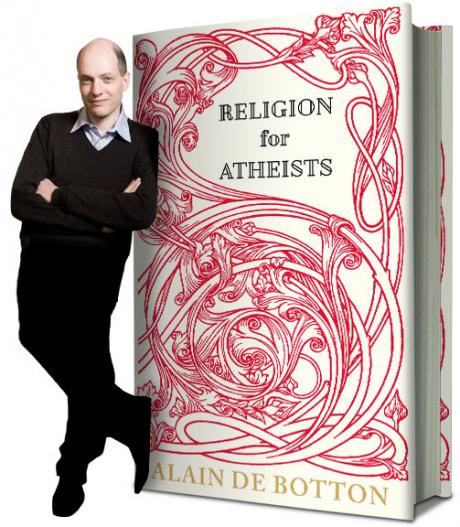
Enjoying the chance to read whilst on sabbatical and find myself enjoying Alain de Botton's latest book, Religion for Atheists.  Starts from the viewpoint, "there's obviously no God", but then spends the rest of the time asking how can we be atheist and still have some of the great things that religion provides?  It's a very interesting book, he has some interesting insights as well as some frankly odd ideas.  Loved this quote from the book: 

“...we face temptations which we revile in those interludes when we can attain a sufficient distance from them, but which we lack any encouragement to resist, much to our eventual self-disgust and disappointment. The mature sides of us watch in despair as the infantile aspects of us trample upon our more elevated principles and ignore what we most fervently revere. Our deepest wish may be that someone would come along and save us from ourselves.”
Religion for Atheists, page 77. Alain de Botton

Which is interesting. 

Asked by a friend what this means.  I think it's pretty much what Paul writes in Romans 7:

 "21 So I find this law at work: Although I want to do good, evil is right there with me. 22 For in my inner being... I delight in God’s law; 23 but I see another law at work in me, waging war against the law of my mind and making me a prisoner of the law of sin at work within me. 24 What a wretched man I am! Who will rescue me from this body that is subject to death? 25 Thanks be to God, who delivers me through Jesus Christ our Lord!" 
I am sure to be levering this into a sermon sometime soon after my return in the summer. 

Wednesday, 14 March 2012

What am I worth?


Weird but wonderful story in the paper recently.  Last week's Guardian (I was slow to pick up on it) reports that a Portuguese man is suing the Baptist Union of Great Britain for £10 million.  (A quick look at the accounts would put him off). 

The basis of his claim is that he 'wasted' 19 years working as an evangelist when he could have been playing football.  He was formerly a player in the Portuguese Third Division and his claim is that he could have earned £20,000 a week playing for Man Utd. 

"I could definitely have had a long career in the Premiership," Arquimedes Nganga said. "I see many players playing today who I am not inferior to – and perhaps even better than".
Nganga has filed papers at the high court, accusing the leaders of the Baptist Union of Great Britain of destroying his social life, causing him "psychological harm" and defrauding him of money through compulsory donations.
Full story (and it really is not an early April Fool's joke) is in this Guardian article. 

Thursday, 1 March 2012

Touching the leper


The following is a quote from Jon McGregor's third novel, "Even the dogs..."

Sorry if any of the language offends, but I thought this was a subtle but deliberate (in the context of the novel) allusion to Christ touching the untouchables.  Of course, I might be reading too much into it, but from the title onwards, there are touches in there that seem to allude to the Bible.

The context here is of a homeless man who is addicted to drugs, getting his feet looked at. 

"Sat and waited and when it was his turn he took off his boots and socks and stretched out his feet for her.  One thing the army taught him was how to look after his feet, and he always made sure he had a pair of dry socks to be going on with, always aired his boots at night if he could.  Some things, when you've been doing them every day for years, you get stuck with them no matter how drunk you are. 

Nothing wrong with these feet, the chiropodist told him, cupping one in each hand and running her thumbs along the tendons and joints.  You must be doing something right, she said, smiling.

Didn't forget that one.  Things like that stick with you, even with all the gaps.  Things like then she washed and dried his feet, and cut his toenails, and rubbed away the hardened lumps of skin with a pumice stone before giving him a new pair of socks and asking him to send the next one in. Most people going out of their way not to touch you all day, to not hardly brush up against you or even catch your eye or anything.  And then that.  Washing and drying and holding his feet, one in each hand.  Things like that stick with you, on the whole.  Could sit and wait all day for a thing like that. 

Watching Ant stirring away at the mess in the spoon and remembering all this.  Waiting.   

Same with the hairdressers, when they go running their fingers through your hair.  Same with the nurses, changing your dressings or taking your blood pressure or listening to the crackling in your lungs, they got to touch you with their clean soft hands and no one says nothing about it but it all helps oh Christ but it helps."   (pages 72,73)

I started Even the dogs, thrilling at the beautiful way that McGregor writes - and he certainly does.  But the novel is pretty tough, a relentless circle of drink, drugs, death, and an autopsy thrown in for good measure.  It's cleverly done but not a light beach holiday read.  I still prefer his first novel, "If nobody speaks of remarkable things".

Wednesday, 18 January 2012

Don't take care, take risks


Vicar of Baghdad, there's a job that you probably wouldn't volunteer for.  According to the Christian Today Website Iraq once had 5 million Christians, now it has 200,000.  Christians in Iraq face financial hardship, political instability and the threat of attacks from extremists, and so many have fled to the relative safety of Kurdistan. 

Canon Andrew White is our man in Baghdad, where his Anglican church runs a clinic and relief programme.  The church is in a hard situation there and yet his advice to us in the UK is telling: 

“Don’t take care, take risks and make sure that the church is totally and utterly relevant. The reason I became a clergyman was because I was too bored sitting in the pews. There are so many churches that aren’t full of life.”

Tuesday, 17 January 2012

Dear Mariella, Should I go to church?


The Baptist Union news service brings to my attention this interesting piece from the Observer last Sunday.  A women working 60 hours a week and seemingly getting abuse rather than support from her husband, writes to ask whether church is the answer.  Atheist Mariella has some interesting and rather surprising thoughts:

Mariella Frostrup's interesting reply

Wednesday, 28 December 2011

Pesky Baptists!


"At many of the pivotal points in my life I've found that the best way to make a decision is to find out what a Baptist would do, then do the opposite."                                Alan Partridge.


(It's from "I, Partridge: We need to talk about Alan", page 288. A Christmas present from my favourite parishioner - already finished.)